Showing posts with label Recreate it. Show all posts

Tuesday, 9 April 2013

‘Using your nous’ with Diane Holuigue


It may sound like a cliché to call Diane Holuigue ‘Australia’s Julia Childs’, but with her wealth of knowledge and ability, the comparison is only natural. Her impressive career spans formal training at Le Corden Bleu and L’École de Perfectionnement Lenôtre in Paris as well as writing for, and editing many of Australia’s best culinary journals. Her extensive knowledge and experience is recorded in thirteen books, but most recently, a hefty 752 page tome titled ‘A Lifetime of Cooking, Teaching and Writing from The French Kitchen’. Di has been conducting classes from ‘The French Kitchen’ for 45 years and has reportedly taught 64,000 people.

Thanks to the Husband, I was fortunate enough to spend a glorious day in Di’s kitchen, basking in delicious aromas and eagerly absorbing her freely dispelled knowledge.  Her large kitchen is filled with enough red crockery to serve a small army and an enviable collection of copper pots and pans. It is a large but cosy space, perfectly equipped for our group of seven eager cooks.

Some classes I have attended are heavily focused on preparing a specific meal, which whilst delicious, you may not ever attempt again. Although the group works to build a delectable four course feast, the six hour preparation time is crammed full of miscellaneous tips and the teaching of techniques to build your cooking skills. This is a class that experienced home cooks will enjoy as much, if not more, than a person who struggles to boil an egg. The techniques taught are entirely practicable and adaptable for every home cook. As pragmatic Di writes in ‘The French Kitchen’, “it is the logic and the technique behind cooking that allows us to put a great meal on the table”.


Soufflé Au Fromage & Soufflé Aux Crevettes

After hearing so many stories of soufflé failures, I had never attempted to make one, let alone a seemingly daunting task such as prawn soufflé. Di demystified the process with her no-nonsense, direct teaching style. Her teaching resulted in the creation of a perfectly risen soufflé. The prawn soufflé was my delegated dish, and I was surprised at the relatively few steps involved. 

The prawn soufflé involved creating a ‘prawn essence’ with the prawn shells, and used the prawn meat in the soufflé. The result was a gloriously pungent and rich liquid. I even departed the class with some leftover prawn essence for my freezer!


My ingredients at the ready. Note the prawn essence!
 

We discussed at length, and viewed, the difference between egg whites whipped by hand and egg whites whipped with machines. The verdict, do not use a machine (yes, even your Kitchen Aid or Thermomix!) to whip your egg whites for your soufflé.
 
Ready for the oven, with baking paper "collar" to guide "the rise"!

Although I may not make soufflés regularly, the skills regarding the roux creation, the prawn essence and the egg white whipping are invaluable. These skills are equally transferable to the creation of other sauces and egg based dishes.
 

All done!
 
Deep Fried Wasabi-Pea Squid

Similarly with this recipe, I found the techniques involved in the recipe, rather than the result itself, to be of use. Di demonstrated and discussed the differences in cleaning and preparing whole squid, calamari and cuttlefish. I’ve cleaned and gutted fish, but always incorrectly assumed that squid was more difficult to clean than a fish due to the presence of ink sacks. The squid dish itself was coated in a deliciously crunchy and inventive crust of panko and wasabi pea. The squid was served with a yogurt accompaniment and a freshly made mayonnaise. The mayonnaise was so delicious I will never purchase store made mayonnaise again.  Yet another skill I’ll be looking to incorporate more often into my cooking.


 Canard Roti, Sauce A L’Anise Etoile

Next up, roast duckling with star anise red wine sauce. The main techniques involved in this dish were the preparation of the demi-glace and the duck reduction and the method of trussing the duck.

Di also demonstrated the trussing of the duckling, executing the trussing with the skill of a surgeon, as she pierced the bird with the needle bundling the bird into a net parcel. The bird is perfectly shaped and ready for the oven.

We had extensive discussions regarding the demi glaze “base” and the subsequent duck reduction, followed by numerous tastings to experience the development of sauce resulting from the additions of the various flavour elements. The time required to prepare a proper demi-glace is well spent, and produces a result far superior to store bought stock. For example, if your demi-glace is destined to accompany duck, it is created with the neck and the wings. If destined for beef, it is made with beef trimmings or mince. The additions to demi-glace sauce can then vary between redcurrant jelly, pomegranate molasses, balsamic or fruit based vinegars depending on the dish is used for. The result – a delicious sauce with depth and intensity.

Draining the fat from the ducklings


Le Concorde

Le Concorde is essentially layers of chocolate meringue sandwiched together with chocolate mouse and decorated with meringue “spikes”. A most impressive, rich dessert which I’m looking forward to replicating.   Unlike the soufflé, the egg whites for the mousse are able to be whipped in the Kitchen Aid. The technique in this dessert which hit home for me was the technique of piping the meringue, and the creation of the “spikes”. Once you’ve mastered the piping bag, the creation of the “spikes” is so simple, but created such an impressive dish.

Preparing the layers


The finished product

I’ll be kept busy pouring over Di’s latest book, a delightfully descriptive and instructive text filled with not only technique and recipes, but stories of adventures past. I look forward to future classes with Di in order to build my technical repertoire.  As Di says, “home cooking is a mix of common sense and application” and on that basis, in the kitchen “just use your nous!”


Tuesday, 30 October 2012

Trend: Street Food


Food trends are temperamental beasts, they fill restaurants to the brim and feed the masses of eager diners. Melbournians love a food trend and are prepared to wait for hours on end for tacos at Mamasita or a table at Chin Chin. No bookings policies make entry into these trendy restaurants harder than a popular nightclub.  Lining up for a meal is a Melbourne badge of honour, a symbol of your commitment to the cause. Melbourne isn’t about where you party, it’s about where you eat. Often it becomes about how long you wait.
What to do if you are not inclined to wait five hours for a table on a Friday night? Here are some easy recipes for ‘on trend’ street food below. You’ll have friends and family lining up for sure.

Spanner Crab Roll
When I arrived in Melbourne, the must-eat dish was the New England Lobster Roll at Golden Fields, and now every second restaurant seems to have a variation on the trend on their menu.  Lobster is prohibitively expensive in Australia, and is reserved for special occasions only. Crab is a more purse friendly option. I chose Spanner crab which is a relatively meaty crab with a delicate flavour.


 (Recipe adapted from the one I’ve eaten at Golden Fields)
·      Eight Brioche rolls/soft white rolls – mine were from Noisette Bakery in Port Melbourne

·      Six Cooked Spanner Crabs purchased from Aptus Seafood in South Melbourne Market

·      Water Cress

·       Kewpie Mayonnaise (Japanese Mayonnaise available from Asian supermarkets, or even Coles)

·        One lemon

Remove meat from Spanner Crabs – see here for technique). 

My spanner crabs ready for battle
Mix Kewpie Mayonnaise with a squeeze of fresh lemon juice. Cut rolls in half, butter them, and grill in hot pan for a couple of minutes to warm through. Spread mayonnaise mix on the bottom of the rolls; add Spanner crab meat, some water cress and some spring onion.  

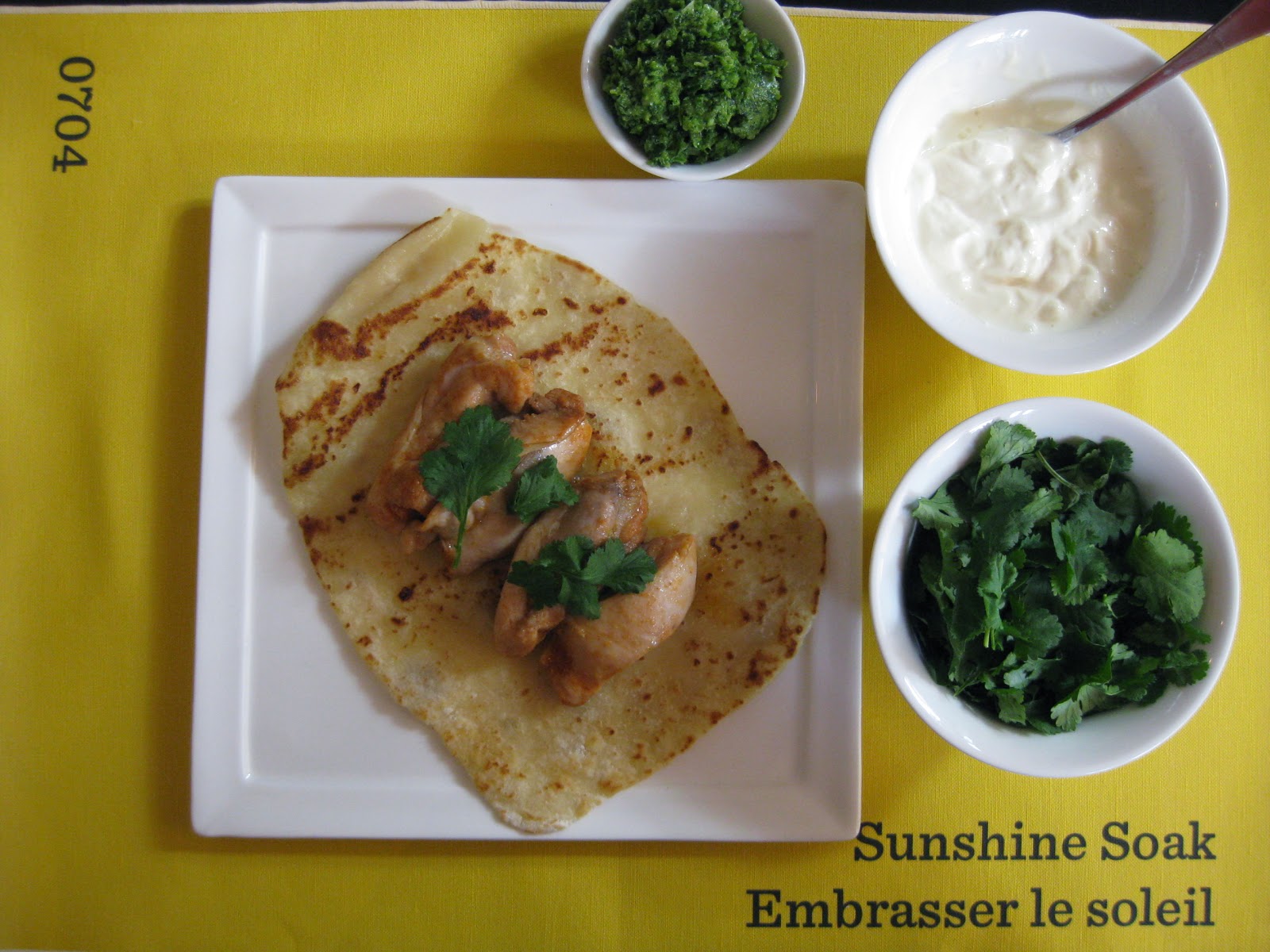
Grilled Chicken Tacos with Salsa Verde
(Slightly adapted from Donna Hay magazine Issue 59, Oct/Nov 2011, subscribe here).

Homemade tortillas are a revelation, and truly make this dish something special. Tortillas are so easy to make, and are completely delicious.  You will never buy pre-made tortillas again.


Salsa verde
·         2 long green chillies, chopped

·         1 clove garlic, chopped

·         2 spring onions, chopped

·         ¼ cup coriander leaves

·         ¼ cup mint leaves

·         2 tablespoons of vegetable oil

Place all ingredients in a food processor and pulse until combined, chill in the refrigerator until required.
Flour tortillas
·         4 cups of plain flour

·         1 tablespoon of sea salt flakes

·         50 cold butter, chopped

·         2 ½ cups of boiling water

Place flour and salt in a bowl and combine. Mix in cold butter and rub the butter in with your fingers until the mixture resembles breadcrumbs. Add boiling water, and mix with a wooden spoon until dough comes together. Knead until a smooth dough forms, and divide into sixteen equal size pieces, and roll out each piece into a 20 cm or so round disc. Cook the tortillas in batches for 1 – 2 min in a hot pan with the vegetable oil. 

Chicken
·         4 x 200 g chicken thigh fillets (cut into strips or bite sized pieces)

·         1 teaspoon onion salt

·         ½ teaspoon chilli powder

·         2 teaspoons paprika

Toss all ingredients into a bag or a bowl, and the coat the chicken with the mixture. Cook the chicken for 4 – 5 minutes in a hot pan, or until cooked through.  (Note: if you like a lot of chicken in your taco, double the recipe).
Serve with coriander and sour cream.
Currywurst
A visit to Berlin is not complete without experiencing currywurst.  After steins of beer, no dish will ever taste so delicious. I don’t even particularly like sausage, but after visiting Berlin, I was a currywurst-convert. There are many variations of the tomato based sauce, with varying strengths of ‘curry’ flavour.

Currywurst is said to originate in war-torn Berlin in 1949. An entrepreneurial housewife named Herta Heuwer traded wares with British soldiers, and in return received some curry powder. Using her new curry powder, she created a tomato based sauce and poured it over sausages and served it at a stall on the red-light district.  Her currywurst became popular with local builders and labourers, and soon became a Berlin institution.


(Recipe adapted from Lonely Planet’s ‘The World’s Best Street Food’, available here)

·         2 tablespoons of vegetable oil

·         1 onion, finely diced

·         2 tablespoons of curry powder

·         1 tablespoon of hot paprika

·         2 teaspoons of Keen’s mustard powder

·         2 cups of canned tomatoes (break up the tomatoes if whole, or use tins of pre-chopped tomatoes)

·         ½ cup of white sugar

·         ¼ cup red wine vinegar

·         5 mild sausages

Heat oil in a pan and add onion, cooking until soft. Add curry powders and paprika and cook for a minute. Add tomatoes, stir in sugar, vinegar and add salt and pepper to taste. Bring the mixture to the boil, reduce it to a simmer and cook until thickened (20 – 25 minutes, depending on the pan and heat used).
Remove the mixture from heat and blend the sauce in a food processor or use a stick blender. Strain the mixture to ensure it is smooth. Cook the sausages as per normal, slice into discs and pour the sauce over the sausage segments.

Duck fat chips
Currywurst is not complete without chips. Mine are created by chopping a good roasting potato into finger-like strips, and roasting them in a baking tray with a couple of tablespoons of duck fat. Deliciously bad for you.

I served the currywurst in bamboo dishes purchased from the Chef’s Hat, in South Melbourne (buy online here).
Note: Food photographed on this lovely tablerunner from The Super Cool, they come in large and small, and you can even buy matching placemats. If you are in South Melbourne Markets, make sure you check out their store. They stock fantastic home wares and many other quirky items. If you are not in the area, they also sell online here.

Sunday, 19 August 2012

Plating Up

“One of the nicest things about life is the way we must regularly stop what we are doing and devote our attention to eating.” Luciano Pavarotti
The anniversary of our move to Melbourne was cause to gather together friends both new and old for a celebration feast. In the whirlwind of a working life, it is so enjoyable to visit a friend’s home and share a meal. My parent’s dinner parties, both hosted and attended, were a regular fixture of my childhood Saturdays. Despite the increasing interest in food, the rise in Masterchefs and documentaries of extraordinary culinary feats, it appears that people have become more hesitant to play host and instead choose to meet out. Whilst this is good for the ever increasing restaurant scene, the art of entertaining is a fading star.
In my view, having friends for dinner is similar to a piece of string – the piece of string is as long as you like, and you choose how complicated your knots are. In reality, a dinner is really all about planning. I rarely have free time during the week, so my planning and preparation took place on weekends.
My preparations began one month from the date, with the setting of the menu. The existence of my extensive collection of food magazines and cook books was justified, as the merits of recipe after recipe were weighed up. The dinner party was a good reason to explore cooking with a new ingredient (hello truffle!) and also to make a new purchase (Kitchen Aid Ice Cream attachment). In constructing my menu, I searched for wintery flavours, but also sought to avoid building an overly heavy menu. I also focused on recipes which could be prepared prior to the evening which would mean the labour during the evening could be reduced.
 A Celebration Menu for Fifteen
·         Scallops with Saffron Crème
·         Mushroom Broth with Truffle and Tuscan Cabbage
·         Beetroot Ravioli with Sage Butter
·         Beef Cheek with Celeriac and Potato Mash
·         Lemon Orange Creamy Ice Cream and Blood Orange Sorbet
·         Chocolate Truffles and Cheeses
For the above, I based the broth on a Jacques Reymond recipe from his book ‘Cuisine de Temps’, Beetroot Ravioli mix from the SBS food magazine, ‘Feast’ issue 12, Maggie Beer’s beef cheek recipe available online here, Kitchen Aid ice cream recipes found in the Ice Cream attachment manual, and Gourmet Traveller’s chocolate truffles from their ‘Slow Food Cookbook’ of 2011. Scallops and saffron crème, Tuscan cabbage chips, mash and winter salads of my own creations.
The setting of the menu also involved the preparation of the shopping list. This is important, as it controls costs and portions, and ensures you don’t rush to the market and buy one of everything “in case you need it”, you don’t! Don’t partake in the last minute ingredient grab, this isn’t the ‘Price is Right’.
I broke down the dinner into the following tasks:
·         Ordering the beef cheeks from T.O.M.S and arranging delivery. This was necessary as I needed to marinate the cheeks the day before cooking;
·         Sourcing ingredients and items that would last the week, for example, potatoes, mineral water, pasta flour etc;
·         Picking up table decorations (in my case place tags, serviettes);
·         Making the ice cream and the sorbet; and
·         Making the chocolate truffles.

Fantastically orange fresh yolks


Lemon and Orange ice cream cooking away


Churn baby churn!


Truffles ready for refrigeration


Thursday – Friday

·         Beef cheeks are delivered, and marinating commenced Thursday night; and
·         Friday night, table is set up, cutlery and glasses washed and set out.


Marinating cheeks


Fantastic reason to use some lovely wedding gifts - Georg
Jensen water jug and salad bowl,
antique brass candles holders


Set and ready to go!


Saturday
·         Early trip to the South Melbourne Market for the fresh items predominately from Georgie’s Harvest and Aptus Seafood for the scallops, mushrooms, beetroots, crème fraiche, truffle, salad leaves etc;
·         Beef cheeks on to slow cook (from approximately 11 am);
·         Prepare the mushrooms broth;
·         Drinks on ice;
·         Make beetroot filling and pasta;
·         Mix the saffron and lemon juice into the crème fraiche;
·         Prepare potatoes and celeriac, and leave subsided in water (as late as possible, so you don’t lose too much flavour)

Browning, in preparation for slow cooking


The most amazing Victorian black truffle,
exclusively stocked at Georgie's Harvest


Slice, slice. Honey Brown Mushrooms from Tasmania
also from Georgie's Harvest


During the Evening
·         Grill the scallops, pipe on the saffron crème;
·         Oven bake the Tuscan cabbage;
·         Warm the mushroom broth and slice the truffle onto it;
·         Cook the ravioli and the sage butter;
·         Make the mash; and
·         Prepare side salads of mixed leaves and sliced radishes.


The end result
Plating up the scallops, slightly messy as the heat
melted the creme


Plating up, loving the truffle!


And on the table, dinnerware also wedding gifts -
Royal Doulton Signature Platinum


Beetroot ravioli


Beef cheeks

The beef cheeks worked perfectly, as Maggie Beer recipes normally do! The mushroom broth was delicious, but does require many mushrooms and much slicing. 

Lemon Orange Ice Cream and Blood Orange Sorbet


The army of dessert at the ready!

I was also happy with my ice cream and sorbet, for a first attempt with my new Kitchen Aid attachment, they were a little icy, but I was happy none the less. Chocolate truffles were also a hit. I really enjoyed the buzz of rapidly ‘plating up’ the dishes, working in a professional kitchen must be stressful and exhilarating all at once!
Ultimately, it doesn’t matter what food is on the table, it’s the act of gathering friends in your home which is the fun part.  So next time, don’t meet at the local pub for a meal, get a little organised and host your friends. The effort is well worth it, and you’ll be repaid tenfold in the joy and appreciation of your guests.
What I’d change: I would not try to make 30 perfect beetroot ravioli again. Although delicious, it was very time consuming to make for fifteen people, even for a regular fresh pasta maker.
What I loved:  Having so many friends, from various walks of life, in our home. The deafening jokes and laughter. Laughing hysterically at a ‘Fifty Shades of Grey’ reading by a guest taking the stage.


Wednesday, 4 July 2012

LG Kitchen School @ South Melbourne Market


Stall 90, Cecil Street, South
Melbourne Market

Recent Australian culinary trends haven’t been kind to the humble potato. Currently my Gen Y compatriots are more likely to dish up quinoa, freekah, polenta or couscous than a delicious creamy mash. The spud has become the enemy of the low carb dieter; the tracksuit pants of the vegetables, you’ll always turn to it for comfort but just not in front of your friends.
Perhaps the hunt for the latest trendy ingredient has created somewhat of an abyss of cooking skills regarding more traditional produce and many may be ignorant regarding just how good the potato can be. Last week I was very fortunate to be a guest at the LG Kitchen at the South Melbourne Market for a class on “Spud Heaven – Amazing Tasmanian seasonal potatoes; star of every dish” presented by Georgie Dragwidge of Georgie’s Harvest (remember her here) and chef Emma Mackay.

The LG Kitchen class is a good balance of a little hands on time and a lot of sampling of the dishes!  Our class of ten consisted of a mix of dedicated spud lovers, a couple of bloggers and a former Masterchef contestant. And unlike some cooking classes I’ve been to, this time I learnt a lot of useful things. The best tips I learnt included:


·    Always buy unwashed potatoes – the commercial washing process involves nasty detergents;
·    Boil your potatoes with their skins on, or else the flavour will leech out and your spud will become waterlogged;
·    If you have to rest cut potatoes before use, put them in cold water or they will discolour like apples;
·    Puree any soups containing potatoes if you wish to thicken the soup;
·    When cooking something in a French style, use white onions rather than brown; and
·    If you’re cooking anything with tomatoes, add brown sugar to the tomatoes to bring out the sweetness and reduce acidity.


Energetic Emma


LG screen gave you a bird's eye view of the action!
Check out the bowls of the different types of potatoes at the
top of the screen.

The basic key to spud success is choosing the correct variety for your purpose. Some are great for a creamy mash, some for roasting, some for a gratin, others are best for chips. For example, why mash your Kipfler when it is so much better roasted? And, if you don't know what you are going to cook, buy the Nicola potato - she's the best all rounder.

Our Tasmanian potato lesson plan consisted of: 

·     Seafood Chowder (Pink Eye potatoes)
·     Nicoise Salad (Pink Fir Apple potatoes)
·     Gnocchi Napoli (Blue Zhar and Viking potatoes)
·     Lamb Moussaka (Nicola potatoes)
·     Georgie’s Yia Yia’s skordalia (Blue Zhar potatoes)

Seafood Chowder


Nicoise Salad served with Emma's Tuna Cake
and Yia Yia's Skordalia

Many of the delicious potato varieties we used are hard to find and are definitely not going to be at your local supermarket, so pop down to Georgie’s Harvest at the South Melbourne Market for a visit and quiz her for the perfect potato for your dish.
 

Georgie's Yia Yia's Skordalia, Blue Zhar potatoes,
garlic and olive oil all from Georgie's Harvest

The food was absolutely delicious, and the gigantic portions cried out for over-indulgence. Aside from the fantastic food, a great aspect of the class was the interaction between class members both with each other and with Georgie and Emma. The class is a great way to meet with other like-minded "foodies", so don't be afraid to attend without your plus-one. In fact, it's hard to think of many ways this class could be improved, other than perhaps making the recipe notes a little more detailed, as some of the tips were not included in the notes.

After experiencing just how good gnocchi can be, I decided to try out my newly acquired skills. Emma and Georgie had taught me that hot potatoes are the key to good gnocchi; if the temperature is not above 70°C the starch in the potato will set. Also buy a potato ricer, it makes the process a lot quicker and means you don't burn your hands trying to mash the hot potato. I paired my gnocchi with a simple tomato sauce with Tasmanian Huon Valley mushrooms (also from Georgie's Harvest) and Pork Chorizo from T.O.Ms. I’m pleased to report my guests found that the results were delicious!


Gnocchi, my way.

I had a fantastic evening at the LG Kitchen cooking school, and as you can see from the photo above I've subsequently enjoyed recreating gnocchi at home. Perhaps rather than looking for the latest 'it' ingredient, we shouldn't lose sight of looking to create more with what we have at hand and sharpening our knowledge of, and cooking skills, using produce from our backyards.

Check out the very tempting class schedule here.  Upcoming classes feature topics as diverse as the celebration of truffles, Japanese fusion, inspirational dishes of Vietnam with Geoff Lindsay from Dandelion and a Spanish evening with Josep Espuga (who has worked in Mugaritz in San Sebastian - currently San Pellegrino's No.3 restaurant in the world!).  I'll be booking in fast!